SoFi
Financial Management for Small Businesses
2 Project Managers, 6 Consultants
Product Designer (Consultant)
Jan - May 2024
Figma, User Interviews, Wireframing, Prototyping, AI Design
OVERVIEW
Empowering small business owners to feel in control of their finances
In January 2024, I worked with a team of 6 designers in partnership with SoFi to design and conceptualize a product for a new user group. SoFi wanted to expand its offerings to help small business owners manage their finances confidently.
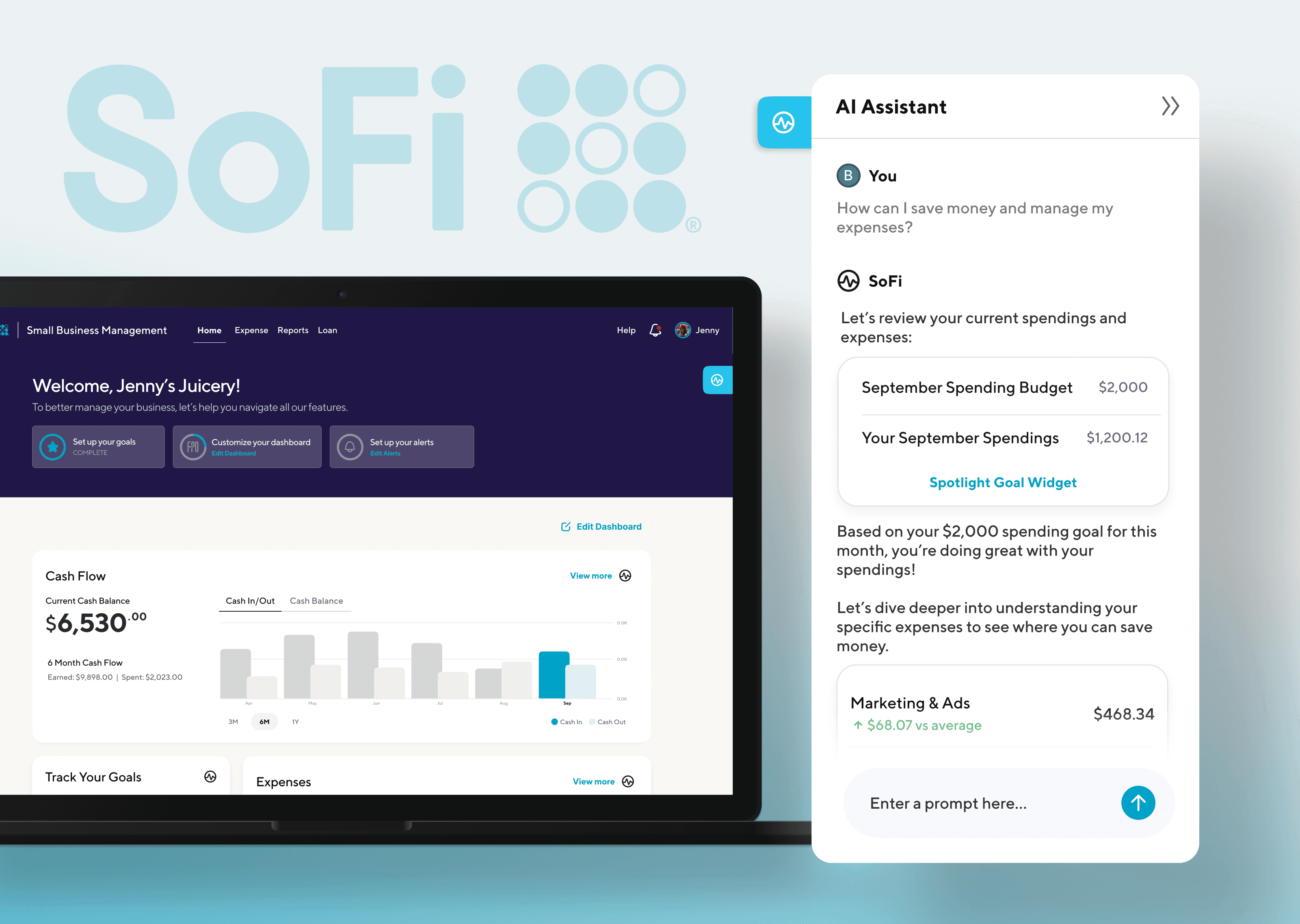
We designed SoFi Small Business Management, a unified system that brings together AI-driven insights, interactive visualizations, and personalized goal tracking to help owners make smarter financial decisions in one place.
My Role & Impact
1
Led the design of 2 core features: a personalized finance dashboard and AI chat assistant
2
Designed a scalable new tool for small businesses that integrates seamlessly into SoFi's existing product suite
3
Drove the narrative and visual direction for final product presented to SoFi design and product leads
RESEARCH & INSIGHTS
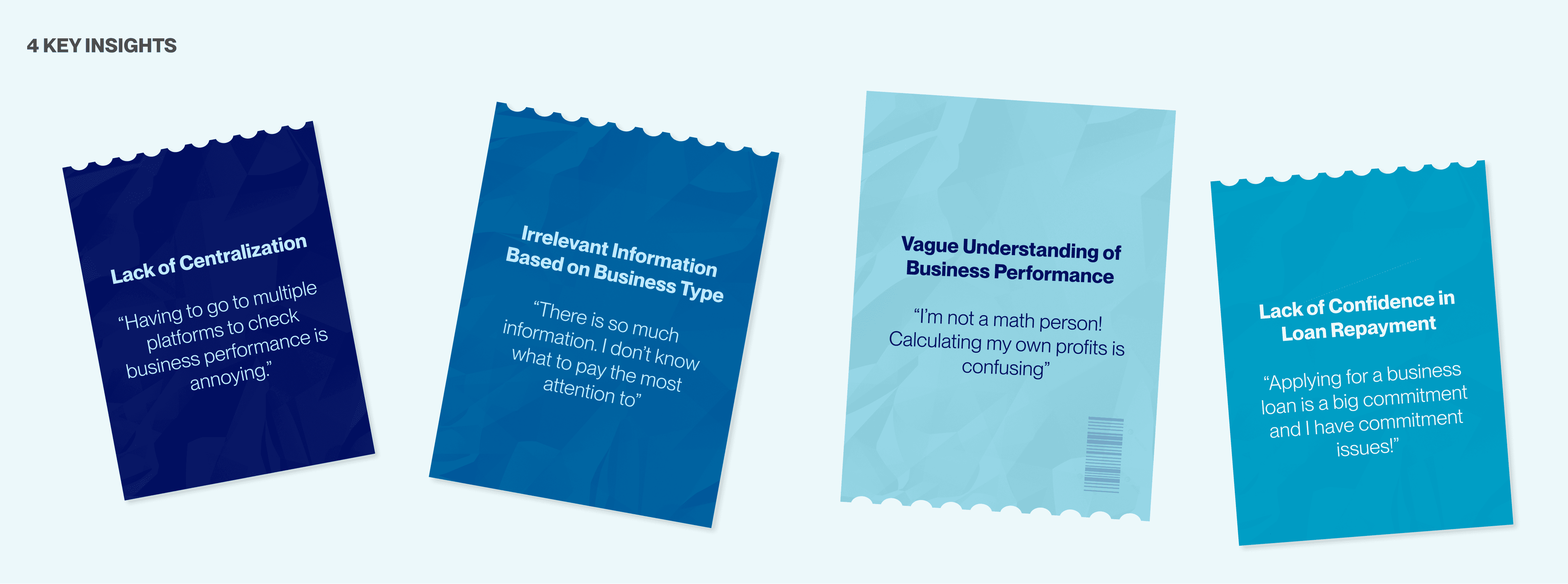
Many small business owners are overwhelmed by numbers and tools not built for them
We conducted 16 interviews with small business owners and uncovered what’s frustrating in their finances.
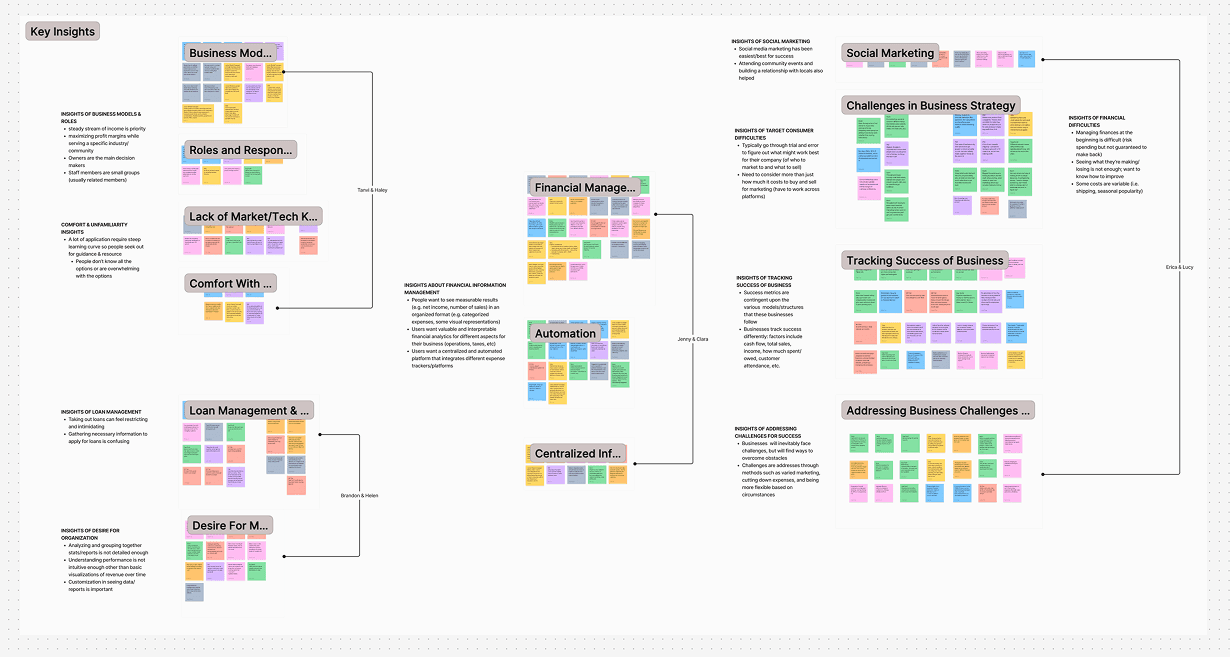
After interviewing small business owners in industries from fashion, children’s toys, food, and more, we found out the following:
Through market research, we established our value proposition
SoFi’s competitors have tech-savvy features and tools, but they lack usability and customer support.
Competitor Platforms




✔️ STRENGTHS
Customizable dashboard views
Task automation
Cash flow analytics
Cross-platform integration
❌ WEAKNESSES
Steep learning curve
Limited loan options
Limited customer service
✨ DESIGN CHALLENGE
How might we help small business owners feel confident managing their finances by turning complex data into clear, actionable insights?
DESIGN DECISIONS
Designing a financial dashboard that adapts to every business
💡 The Goal
Create a personalized experience that helps users focus on what matters most to them, while reducing information overload.
My thinking was that more customization = more relevance
Initial Hypothesis
If we allowed users to customize their dashboards by selecting widgets, we could:
Reduce confusion by limiting irrelevant information
Increase SoFi’s value proposition by showing content tailored to business goals
The first solution: a widget-based dashboard that gave users freedom to choose what data and insights to display
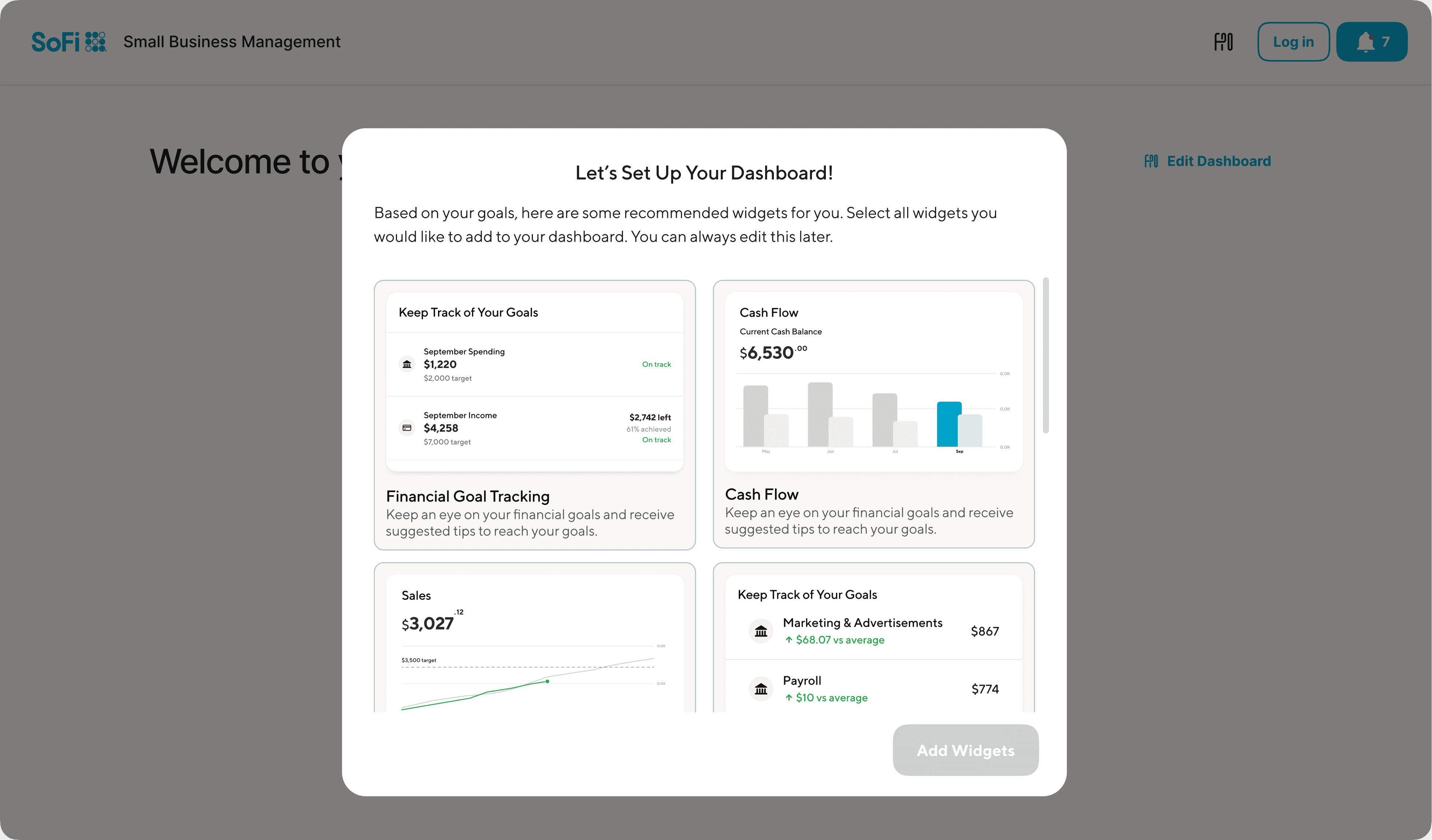
User feedback revealed that flexibility led to decision fatigue, so we reframed the problem.
"There are too many widget choices to choose from… it's a bit overwhelming…" 😮💨
"Everything feels important. I don't know which to choose." 😵💫
We realized that choice isn’t always empowerment, especially for small business owners already juggling multiple responsibilities.
Revised Solution
I designed a new goal-based dashboard that gave users a clearer starting point and a stronger sense of control without overwhelming them.
Fewer decisions upfront
Users begin with a pre-curated view tailored to their goals
Higher confidence
Participants in testing reported feeling "guided" rather than "lost".
Improved user engagement
Users spent more time exploring insights because the dashboard felt relevant from the start
Incorporating AI as a financial partner
💡 The Challenge
Even with a clearer dashboard, users still needed guidance. We wanted to design a system that could offer advice, encouragement, and education.
I explored the concept of an AI assistant chatbot.
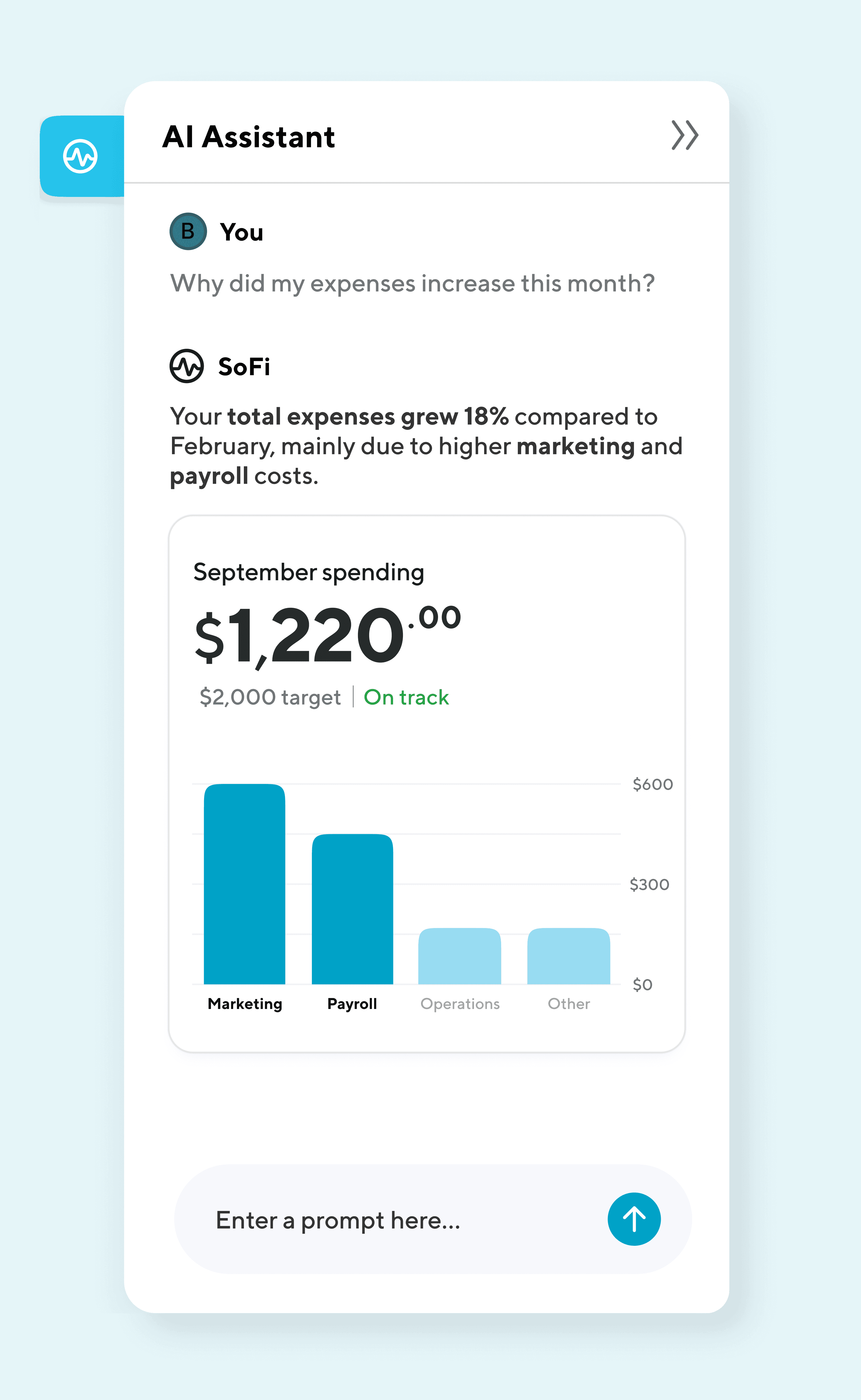
Version 1: Simple Chatbot
Users can type questions and receive AI-driven responses
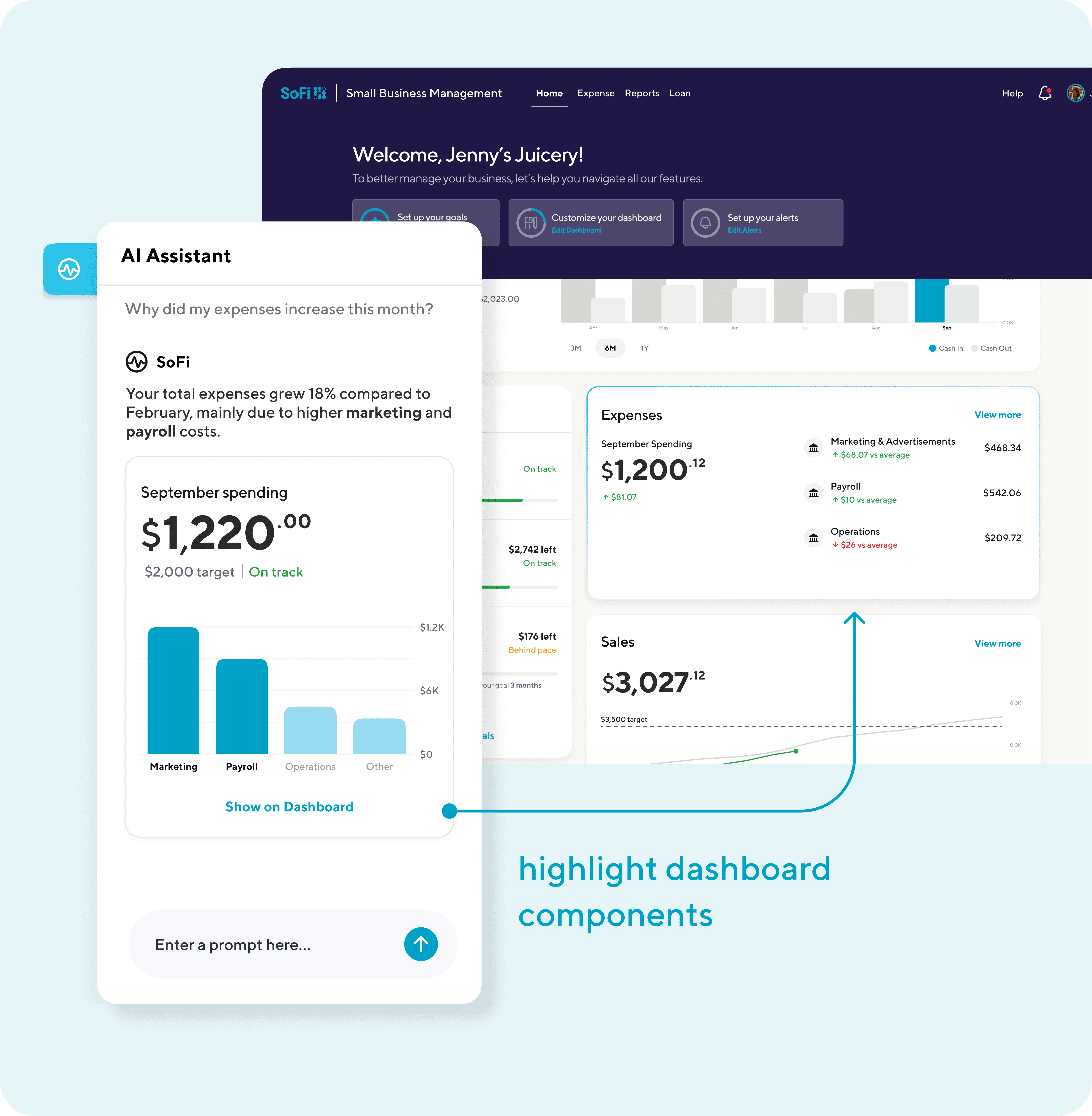
Version 2: Contextual Highlighting
AI assistant provides responses and highlights data sources in the user's dashboard
The AI chatbot provides transparency, but users still don't have a means of taking action.
After exploring a simple chatbot and the ability to highlight data sources straight from the dashboard, I realized users were still struggling to truly understand the data and feel empowered to make their own decisions.
“The AI gives good answers, but I don’t know where to find these numbers in my dashboard.”
“I want to learn, not just be told what to do.”
This led to my final exploration, a guided and educational experience that directly connects the AI assistant to dashboard data and offers actionable insights.
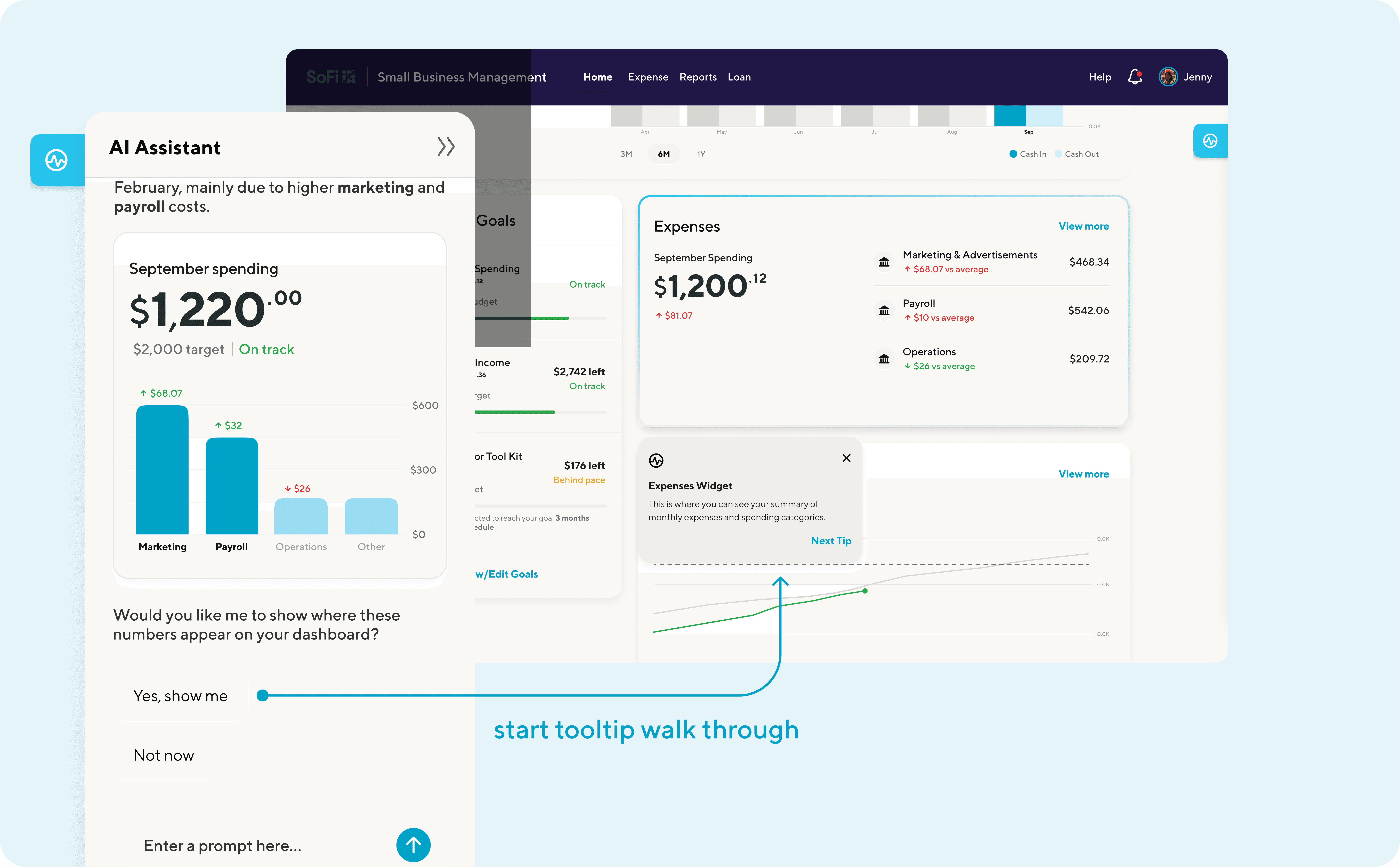
Version 3: Interactive Teaching Tooltips
The AI chatbot prompts users to walk through guided tutorials of how to navigate their dashboard with tips and suggestions on how to interpret and act on their data.
Why this works
AI guidance builds trust
Users viewed the AI as a teaching partner when it explained why data changed, not just what changed.
Education drives user engagement
When users were shown how to interpret metrics in context, they spent 54% longer exploring the dashboard, turning passive users into active learners.
Actionability closes the loop
The final “Would you like to set a budget goal?” prompt converted 72% of users to create a new goal on the spot.
FINAL DESIGNS
After 4 months of collaboration and iteration, we presented the final designs to SoFi design and product leads.
Personalized Dashboard with Widgets
A finance hub that adapts to every business. Users can tailor their view with widgets aligned to their goals, keeping what matters most front and center.
AI Assistant (Chatbot & Interactive Tooltips)
A conversational partner that guides, teaches, and supports, turning financial questions into actionable insights and helping users navigate their data with confidence.
AI Assistant (Prompting users to take action)
The chatbot guides users to take actions based on their data, such as helping them set budget goals.
I helped ensure scalability through cross-collaboration.
Integration into SoFi's product suite
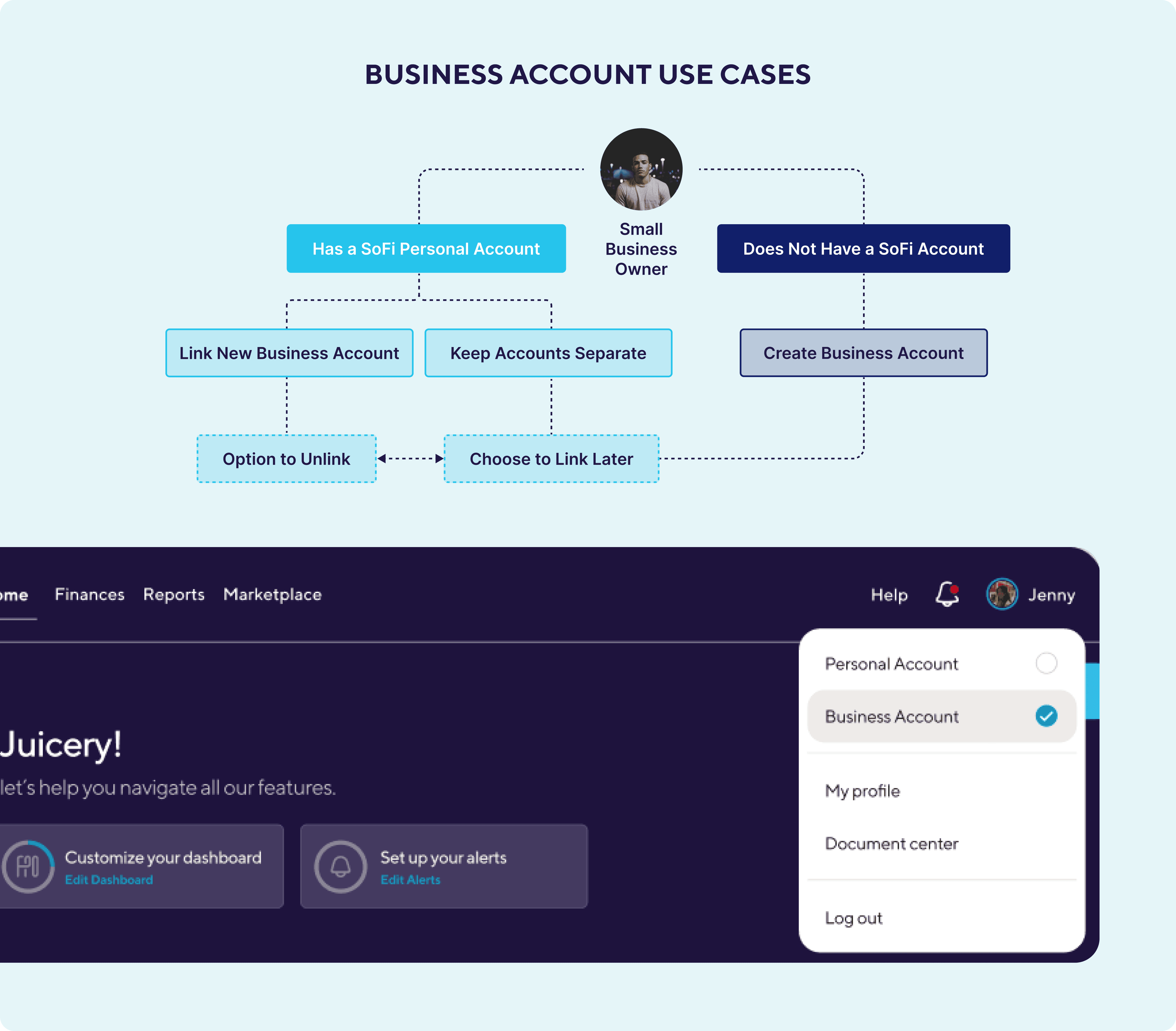
We designed the small business experience to fit seamlessly into SoFi’s broader product ecosystem, whether or not a user already had a personal SoFi account. This meant considering multiple entry points and user flows: onboarding as a new business member, linking an existing personal account, or managing both under one unified dashboard.
Componentized UI patterns
I created componentized UI patterns, for widgets, tooltips, and AI prompts while documenting them in Figma for dev handoff (including states, transitions, etc.).
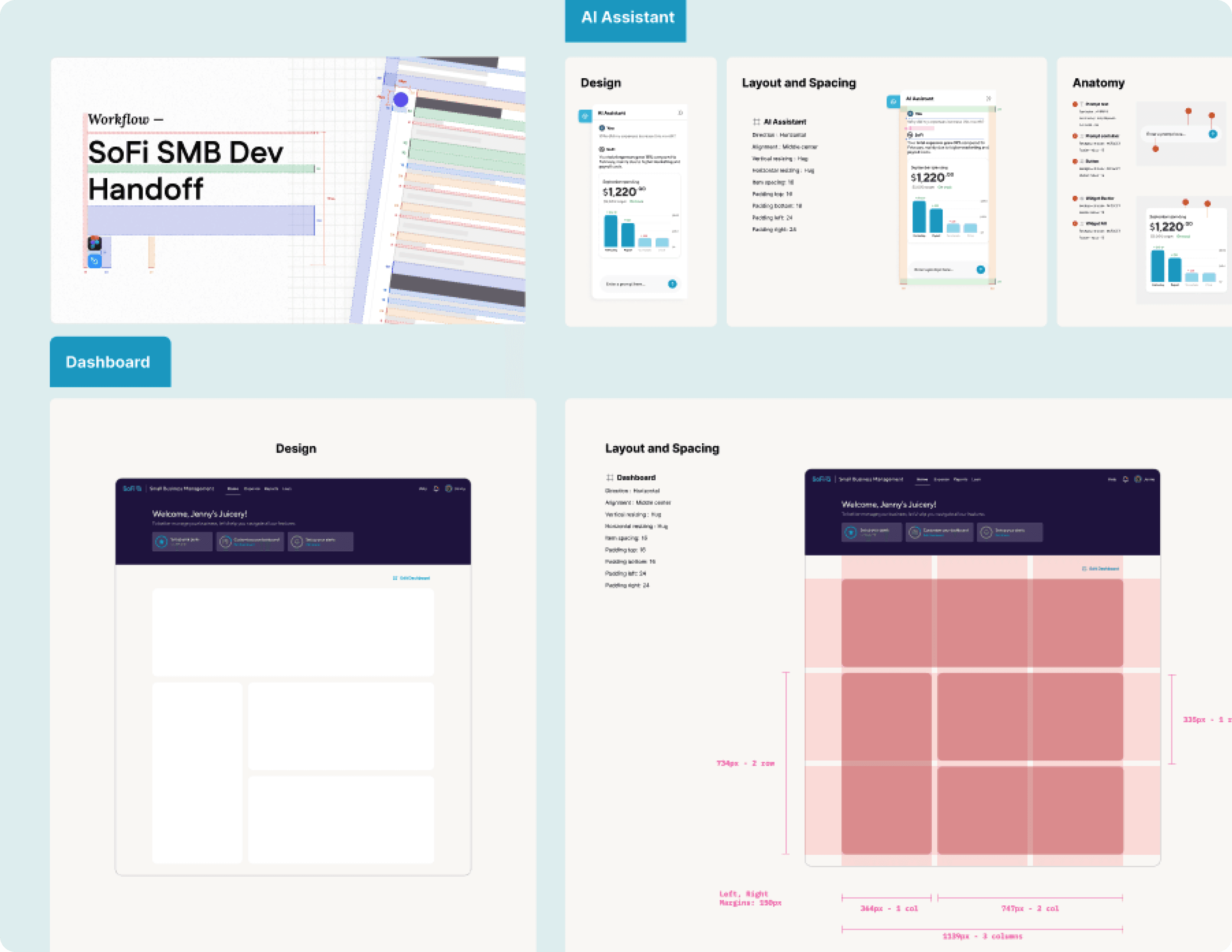
Developer Handoff
UI Changes
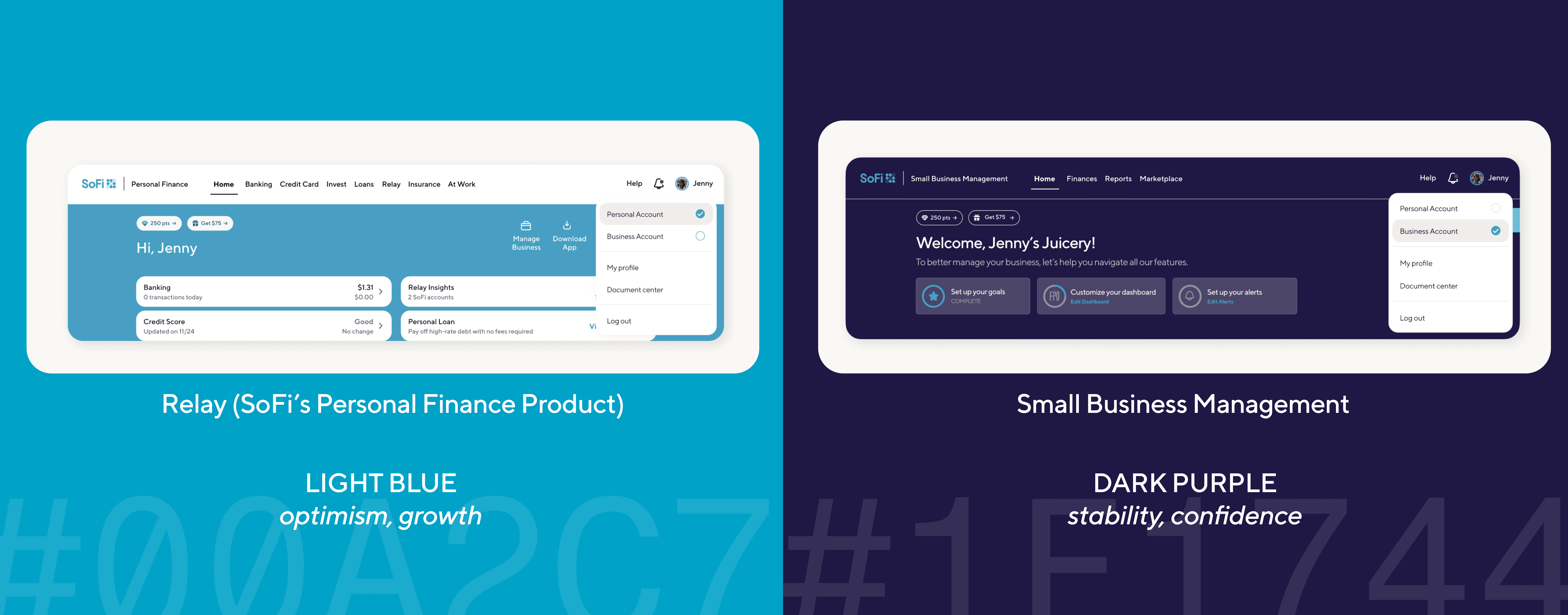
We also defined a distinct visual identity for small-business tools: a deeper SoFi purple and clean typography to convey professionalism.
BUSINESS & USER IMPACT
What does this mean for SoFi?
Expansion into a new market segment
Laid the foundation for SoFi’s entrance into the SMB management space.
Product differentiation
AI-guided experience positions SoFi as a financial learning platform, not just a traditional financial management tool. This builds long-term user trust.
Opportunities for data maturity
The guided AI system produces valuable metadata, allowing SoFi to identify what questions users asked most frequently and identify new product opportunities.
What does this mean for users?
Reduced cognitive overload
Goal-based dashboards and AI tips cut drop-off on complex pages, keeping users focused on what matters most.
Empowered decision-making
Guided insights prompt users to act on their data, shifting from passive tracking to proactive management.
TAKEAWAYS
Reflections & What I Learned
It was a such pleasure collaborating with the SoFi team and the designers on my consulting team. Everyone brought such thoughtfulness and creativity to the table.
Thank you to my PMs, co-designers, and the SoFi product team for an incredible experience! 🩵

Some lessons I took away from this experience…
🩵
AI should teach not just tell.
When we reframed the assistant to teach instead of just answer, users started exploring their data more on their own. It reminded me that the real value of AI in design is helping people think and feel empowered to make their own decisions.
🩵
I learned the value of shared ownership.
While I took the lead in designing the dashboard and AI assistant experience, I quickly realized that the best ideas came from cross-functional collaboration. Partnering closely with PMs helped me prioritize the right problems, and working with engineers early ensured our designs were not only ambitious but technically grounded.